
Advancing Climate-Smart Agriculture - 2013 Annual Report highlights
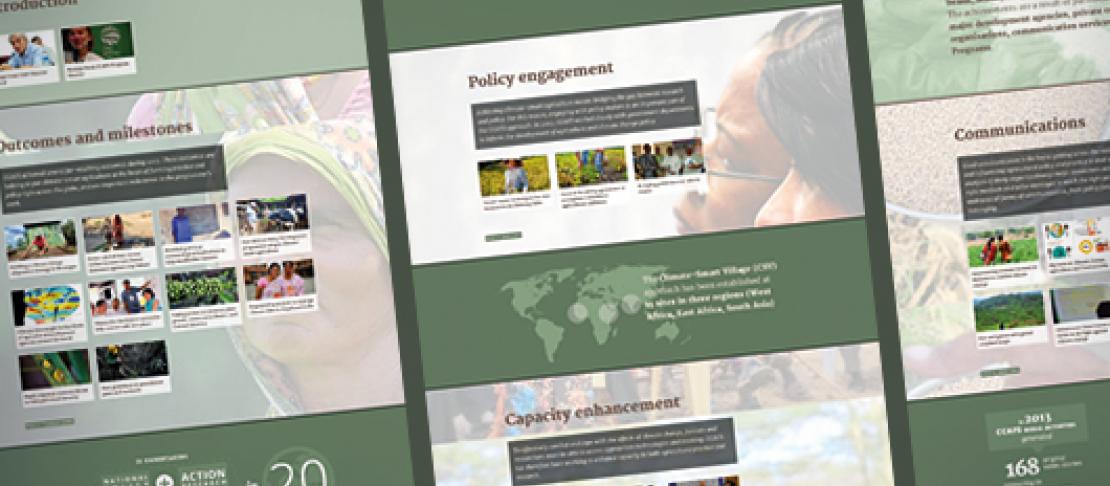

In 2013, CCAFS helped advance climate-smart agriculture in 20 countries around the world, through close collaborations with farmers, civil society, governments and researchers. Here are some of the highlights from our 2013 Annual Report
Achieving sustainable food security while reducing rural poverty, improving health and nutrition and managing our natural resources in a sustainable way, will be a real challenge under a changing climate. In 2013, the CGIAR Research Program on Climate Change Agriculture and Food Security (CCAFS) helped to put climate-smart agriculture at the heart of farming practice and policy right across the globe, helping rural communities to adapt to rising temperatures and diminishing rainfall, to manage the floods uncertain weather, markets and prices.
Reaching millions of farmers
Adaptation to climate change is about building capacity. Knowledge and the ability to use that knowledge is crucial. Capacity strengthening runs throughout CCAFS and at every level, from farmer to global negotiator. In 2013 CCAFS, in partnership with various stakeholders were in training to strenghen the capacity of farmers in South Asia, Latin America and West Africa.
CCAFS supported 14,602 women and 9,455 men on short-term training programs, and 522 women and 622 men on long-term training programs. (Read more about Capacity enhancement)
More than 600 rice-wheat farmers in India learned to apply fertilizer more efficiently, increasing their harvests by up to 1.5 tonnes per hectare. (Read the story)
- 8,500 leading community women received training in climate-smart agriculture in Nepal and Bihar, India. (Read the story)
Getting results on the ground
CCAFS has worked with a multitude of partners to establish 15 Climate-Smart Villages (CSVs) in West Africa, East Africa and South Asia. These villages (or districts or landscapes) serve as a crucial testing ground for different adaptation strategies, technologies and practices. They do this through an empowering action research model, and there is constant interaction between researchers and local people.
The CCAFS program is undertaking national policy engagement and action research on Climate-Smart Agriculture technologies in 20 countries.
The Climate-Smart Village approach has been established at 15 sites in three regions (in West Africa, East Africa and South Asia).
(Read more about Innovative partnerships)
Enhancing capacity of farmers, local leaders and service agencies
We need to work with the agencies that deliver services to farmers. One area of focus is on national meteorological services (NMS). As a result of research and capacity investment by CCAFS and partners, the NMS organisations in three countries now produce climate information at a scale that is relevant to rural communities, using methods, tools and results from CCAFS.
In Senegal, climate forecasts now reach around two million farmers via community-based radio. (Read the story)
Over 5,000 users of the CCAFS-Climate portal, including key development partners, downloaded 135,000 files of climate data generated by CCAFS in 2013. (Read the story)
Creating conducive policies for resilience building
Creating an enabling environment will be vital if we are to achieve ambitious development goals. As a vital step towards achieving this, in 2013, CCAFS analysed the state of national climate change adaptation plans, policies and processes in 12 countries across West Africa, East Africa and South Asia.
CCAFS research influenced Nicaragua´s new national climate change adaptation plan for agriculture, attracting major investment in adapting coffee and cocoa farming to future changes. (Read the story)
Changing the face of research
CCAFS research helps shape global research agendas. Together with partners, including FAO, CARE, IFAD, We Effect and GROOTS, CCAFS is also re-orientating research to better focus on gender issues
To bolster climate change adaptation, Mesoamerican Ministers endorsed a major strategy to conserve plant genetic resources, focused on ten common crops including beans, sweet potato, papaya and avocado. (Read the story)
(Read more about Innovative collaborations and breakthrough science)
- CCAFS media activities generated 168 original news stories appearing in over 30 countries and 15 languages. (Read more about Communications)
In conclusion
The decades of development research directed to “to whom it may concern” are over. Research needs to be closely integrated with capacity strengthening, partnership engagement and creative communications. We hope that the progress reported from 2013 reflects on these aspirations.
To read many more stories from 2013, go to our online Annual Report 2013 site.