

Case Studies: Crop Adaptation to Climate Change
This week, new studies were published on "climate proofing" key crops across the tropics. The studies by the CGIAR Research Program on Climate Change, Agriculture and Food Security (CCAFS) highlight how climate change will impact crops that are critical to food security in the developing world, and what adaptation strategies can help reduce these impacts.
You can now explore the data behind the studies together with photos and videos of farmers in the affected regions on the newly launched Adaptation and Mitigation Knowledge Network. This platform brings information from diverse sources onto an interactive map, to help build a rich understanding of the issues and impacts.
Updated continually with new data, the AMKN is an initiative of CCAFS that draws on information from the CGIAR centers and partners. We present some case studies that can be explored via the map.
Cassava: Too Much of a Good Thing
For cassava, a root crop of South American origin that is grown across the tropics, substantial increases in rainfall—predicted for nearly half of the world's cassava growing area—are a primary cause for alarm, according to one of the new studies. Zoom into a map of current climate constraints (water-logging stress) of cassava in South America.
Yet, cassava generally thrives in challenging environments, particularly under hot, dry conditions, and that's why it has become such an important component of food security in Africa. Some agriculture experts suggest those traits could make the cassava itself an adaptive strategy for farmers seeking to maintain food security in areas where the arrival of hotter, dryer weather makes current staples, like maize, less viable. View a map of current climate constraints (drought stress) of cassava in Africa.
In fact, in some areas, the data shows that climatic conditions will so favourable that yields will increase, for example in Kiaranga village, Kenya, cassava yields are predicted to increase up to 9%.
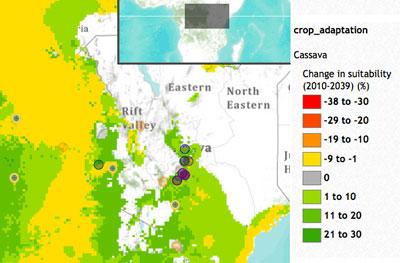
Emily Marigu Ireni defends her farm
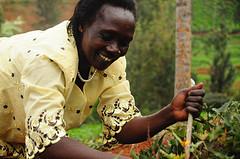 Emily Marigu Ireni, who keeps a small farm in Kiaranga village, has already changed her farming practises due to erratic rainfall. Emily's agricultural adaptations include crop diversification and soil management.
"Because of climate change, I thought it would be good to grow other crops than my coffee, tea, maize and beans. As the rains are less, I started to plant potatoes and sweet potatoes. We have been growing cassava since 6 months and it grows very well." Watch a video interview with Emily.
Emily's move to more diversified crops including cassava looks like a good investment into a safer farming future. Read more about her adaptation strategies.