
Transforming global food systems under climate change: Achieving zero emissions
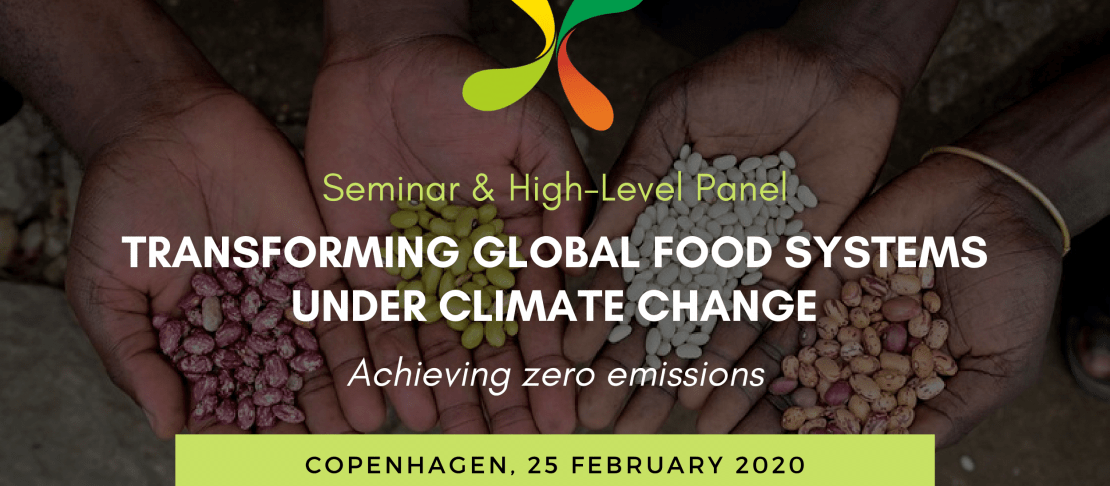
On 25 February 2020, key food systems and climate change stakeholders will come together to discuss solutions that could make our food systems climate-friendly.
There has been a growing call among key food systems and climate change stakeholders for transformative changes in the way we produce and consume food. This event will focus on three solutions for making our food systems more climate-friendly, drawn from a report by a Panel of Experts to be released in early 2020:
- Driving progressive change through collaboration between industry and social movements: facts, youth and networking
- Towards healthy and sustainable climate-friendly diets: current shifts and likely future scenarios
- Reducing food loss and waste
Background
If we are to limit global temperatures to not more than 2°C warmer than pre-industrial levels, then the agriculture and food sector will have to contribute to significant emissions reductions, even though climate change is only one challenge among many for the food system, including global food insecurity, poor nutrition and health outcomes, over-use of water, etc.
Registration for this event is required via Eventbrite.
Already registered?
Download our event app here
Major organizations around the world are making commitments to reduce emissions in the food supply chains. In Denmark, both the Danish Agriculture & Food Council and Danish Crown have pledged to become climate neutral by 2050. At the same time, social youth movements like Fridays for Future are gaining momentum and influencing policy makers to a larger and larger extent. The new Danish government has committed to a reduction of greenhouse gas emissions of 70% by 2030 compared to 1990.
Objectives
The event will break fresh ground by establishing new important links between the agricultural sector and youth movements, to discuss how current commitments to reduce emissions can be achieved, and how these commitments can be scaled up throughout the food supply chain. Given that the challenges are very different between high- and low-income countries, the seminar will try to provide a nuanced perspective.
Many have proposed that food consumption and food waste patterns will need to change. The event will review how diets and behaviors are changing by highlighting exciting examples, including the role of social movements in such changes, and how further change can be fostered.
This event will bring together leading figures in the food system—farmers, consumers, policy makers, researchers, activists and more—in order to attempt to reach consensus on some of the priority solutions, and stimulate greater ambition for a climate-friendly world, as well as greater collaboration between food producers and consumers.
Agenda and speakers
Time | Description | Speaker/Panelist |
Session 1: Opportunities to advance transformative actions in food systemsChair: Ana Maria Loboguerrero, Head of Global Policy Research, CGIAR Research Program on Climate Change, Agriculture and Food Security (CCAFS) | ||
10:00–10:30 | Registrations and coffee | |
10:30–10:40 | Opening by Chair |
|
10:40–10:50 | Welcoming remarks: The challenge | Henrik C. Wegener, Rector, University of Copenhagen |
10:50–11:05 | Scene-setting: Challenges and opportunities for reducing emissions in the food system | Andrew Campbell, CEO, Australian Centre for International Agricultural Research (ACIAR) |
11:05–11:15 | Rising to the challenge: An industry committing | Anne Lawaetz Arhnung, CEO, Danish Agriculture & Food Council |
| 11:15–11:25 | Transparency and accountability: Guidance for target setting and measuring progress | Tony Siantonas, Director, Climate-Smart Agriculture, World Business Council for Sustainable Development |
11:25–12:15 | Panel discussion: Role of social movements and consumers in fostering change in the food system Chair: Christian Bugge Henriksen, Associate Professor and Research Group Leader, University of Copenhagen | Hege Skarrud, President, Spire, Norway Sithembile Ndema Mwamakamba, Senior Program Manager, Food, Agriculture and Natural Resources Policy Analysis Network (FANRPAN) Ben Reynolds, Deputy Chief Executive, Sustain, UK |
12:15–13:15 | Lunch | |
Session 2: Transformation in practiceChair: Katrine Krogh Andersen, Dean, Faculty of Science, University of Copenhagen | ||
13:20–13:35 | Zero carbon agriculture: is it feasible? | Liam Condon, President, Bayer Crop Science |
13:35–13:50 | Reducing emissions from a business perspective | Jais Valeur, CEO, Danish Crown |
13:50–14:05 | Making change happen | Selina Juul, Founder, Stop Wasting Food Movement |
14:05–14:20 | Social movements and our food system | Sophie Healy-Thow, Lead Group Member, Scaling up Nutrition (SUN), Ireland |
14:20–14:45 | Q&A and discussion with audience | |
14:45–15:15 | Coffee break | |
Session 3: Rising to the challenge: Stepping up transformative actions to reduce emissions in food systemsChair: Katrine Krogh Andersen, Dean, Faculty of Science, University of Copenhagen | ||
15:15–16:15 | Panel discussion: Reducing emissions in food systems: What is needed and what is the way forward Chair: Katrine Krogh Andersen, Dean, Faculty of Science, University of Copenhagen | Ida Auken, Member of Parliament, Denmark Katherine Richardson, Leader, Sustainability Science Centre, University of Copenhagen Mauricio Graber, CEO, Chr. Hansen Holding Dhanush Dinesh, Global Policy Engagement Manager, CCAFS |
16:15–16:30 | Closing remarks | Tomas Anker Christensen, Denmark's Climate Ambassador, Ministry of Foreign Affairs of Denmark |
Partners
This event is co-organized by:
- The CGIAR Research Program on Climate Change, Agriculture and Food Security (CCAFS)
- University of Copenhagen
- Danish Agriculture and Food Council
Resources
Website
Media
- Press release: Danish Agriculture & Food Council climate vision
- Op-ed: Why our food systems must be transformed
- Danish coverage: Forskere skal høre om klima i Danmark
- Danish coverage: Vi vil altid først og fremmest være kødproducent
- Danish coverage: L&F klar til at indgå i flere alliancer med landbrugskritiske foreninger
- Danish coverage: Arhnung til klimaseminar: Landbruget er en del af løsningen
- Danish coverage: Jais Valeur talte om bæredygtighed på international forskningskonference
Related publications
- Brief: Actions to transform food systems under climate change: Shift to healthy and sustainable climate-friendly diets
- Brief: Actions to transform food systems under climate change: Drive social change for more sustainable decisions
- Brief: Actions to transform food systems under climate change: Reduce food loss and waste
Video
Session recordings
Presentations
Photos